
By Dr. Gyan Sharma
What Is Panchang?
If you have ever wondered why your grandmother checked the calendar before fixing a wedding date, the answer lies in the Panchang. The word comes from pancha (five) and anga (limb) — so it literally means “five limbs.” It is the traditional Hindu astronomical almanac, and people across India and the diaspora have relied on it for thousands of years to pick the right time for important events.
What makes the Panchang special is that every entry is calculated from the actual positions of the Sun and Moon, using well-established astronomy. Modern Panchang systems use the Swiss Ephemeris — the same engine used by observatories worldwide — along with the Lahiri Ayanamsa, officially adopted by the Government of India, to produce highly accurate results.
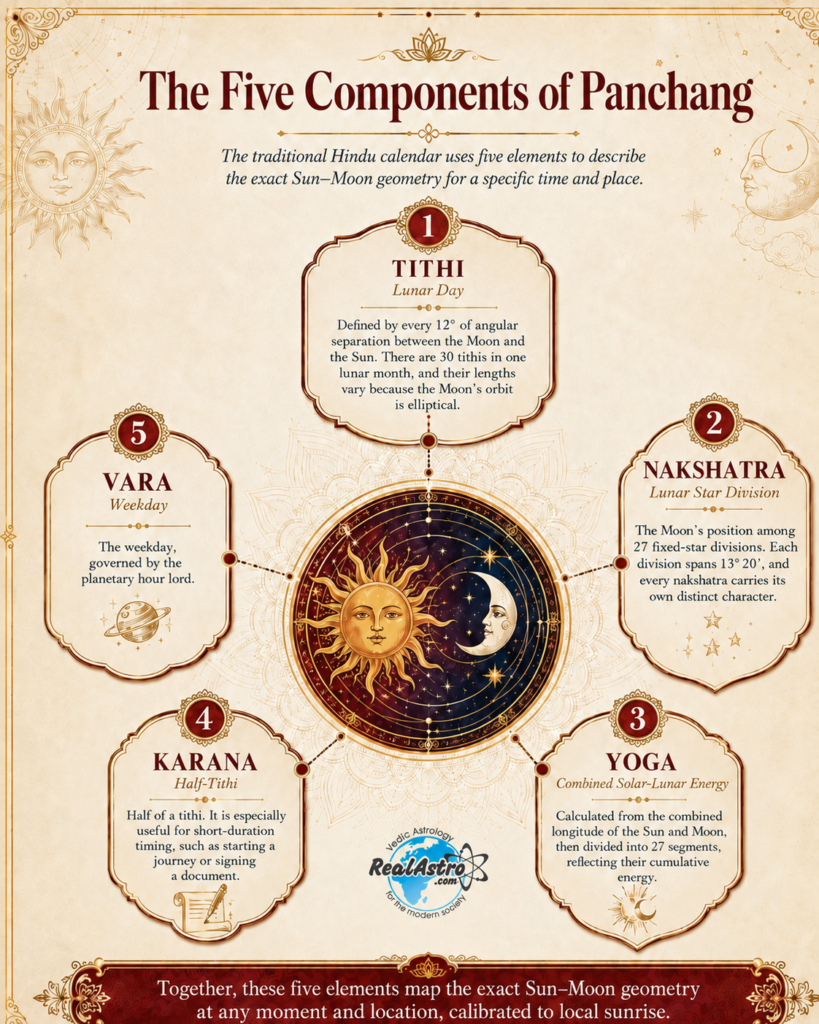
The five components are: Tithi — the lunar day, defined by every 12 degrees of angular separation between Moon and Sun; there are 30 tithis in one lunar month, and their lengths vary because the Moon’s orbit is elliptical. Nakshatra — the Moon’s position among 27 fixed-star divisions of 13°20′ each; each nakshatra has its own character. Yoga — the combined longitude of Sun and Moon divided into 27 segments, reflecting their cumulative energy. Karana — the half-tithi, useful for short-duration timing like starting a journey or signing a document. And Vara — the weekday, governed by the planetary hour lord. Together, these five elements map the exact Sun-Moon geometry at any moment and location, calibrated to local sunrise.
Auspicious Muhurths — When to Act
If Panchang tells you the quality of time, Muhurth is the art of choosing the best window within it. These time slots are calculated from sunrise, sunset, and planetary positions — not from arbitrary tradition.
Abhijit Muhurth
A 48-minute window around local solar noon — the midpoint between sunrise and sunset. The Sun is at its peak, making this the most powerful auspicious period. Ideal for starting a business, signing agreements, beginning construction, or setting out on a journey. Important: it is based on actual solar noon, not 12 o’clock on your watch, so it shifts with your location and season.
Amrit Kaal
From the Choghadiya system, which divides day and night into eight parts, each ruled by a planet. The Moon-ruled segment is Amrit — “nectar.” Best for religious ceremonies, important purchases, or starting medical treatments. Shifts daily with sunrise and sunset.
Vijay Muhurth
Daylight is divided into fifteen muhurths; the thirteenth is Vijay — “victory.” Linked to Lord Rama’s triumph, it is ideal for exams, legal cases, interviews, or competitive pitches. Not recommended for peaceful or spiritual activities.
Godhuli Muhurth
About 24 minutes around sunset — when cattle walk home stirring dust in golden light. Exceptionally auspicious for weddings, griha pravesh, and welcoming someone home. Not suitable for starting journeys or business deals.
Inauspicious Periods — When to Wait
Rahu Kalam
A 90-minute daily window under Rahu, the eclipse-causing shadow planet. Calculated by dividing daylight into eight equal parts with a fixed weekday rotation. Avoid starting anything new — no property registration, no travel, no ceremonies. Routine work already in progress is fine.
Gulika Kalam
Gulika is a highly malefic shadow son of Shani (Saturn) — a calculated shadow point, not a physical body. Its time slot uses the same eight-part daylight division but falls on a different weekday slot than Rahu Kalam. Particularly avoided for health decisions, surgeries, lending money, or financial dealings.
Yamagandam
Linked to Yama, the Vedic lord of death, this is the third caution window from the eight- part division. Avoid starting travel, entering a new house, or beginning studies. Together with Rahu Kalam and Gulika Kalam, these three form daily “caution zones” that practitioners always check.
Dur Muhurth
A short inauspicious window — usually two of the fifteen daytime muhurths — rotating by weekday. Unlike planet-driven Rahu Kalam, Dur Muhurth is linked to the tithi-weekday combination. Avoid auspicious events, large investments, or starting construction during this period.
Why It Still Matters
We live in an age of satellite navigation and Instagram, but the Panchang answers a question no modern calendar can: what is the astronomical character of this moment, at this place? Whether you use it for spiritual practice, planning a wedding, or understanding the rhythms of the Moon, the calculations behind it are solid, reproducible, and grounded in the same celestial mechanics that governs tides and eclipses. The science is ancient. The mathematics is timeless.