
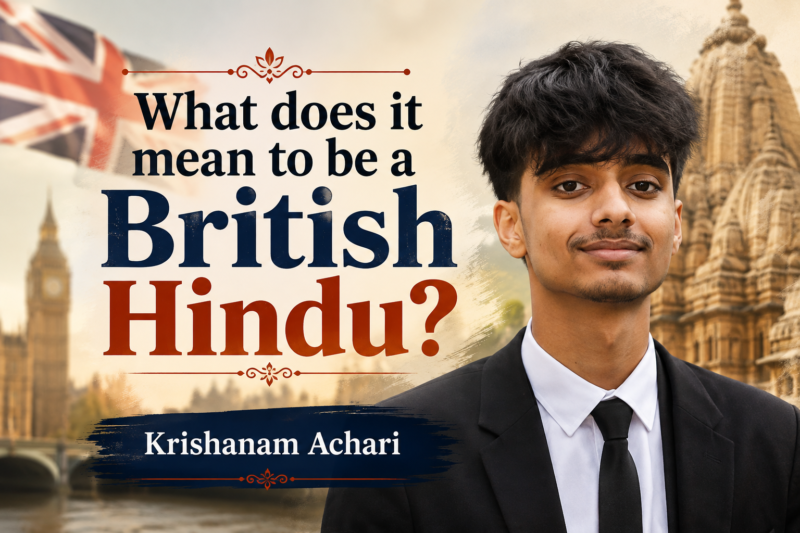
In British politics, immigration has become one of the defining subjects of public debate. The origins of this debate itself is contested. Some scholars argue that it reflects the decline of the state’s capacity to foster national cohesion, following the country’s neoliberal reforms of the 1980s, weakening many of the institutions that had historically underpinned a shared sense of citizenship.
Others emphasise economic explanations, arguing that immigration has intensified competition in labour and housing markets, placing pressure on the livelihoods of lower-income Britons. Yet, for me; the most interesting dimension is that of identity. Across much of the political right—and in more strident form at the far right—the central concern is not principally economic, but rather cultural. The subject of Immigration raises fundamental questions about how a common British identity is sustained in an increasingly diverse society, with critics arguing that multiculturalism has weakened the traditions, institutions, and historical continuity that once bound the nation together. To summarise, the debate is one of both identity and belonging.
For British Hindus, this question is often experienced in everyday life rather than in the abstract. The challenge is rarely one of political loyalty – but one of reconciling two cultural traditions that have developed around different assumptions of faith, family, and community. Historically, the rhythms of British life are shaped by Christianity. The parish church was not merely a place of worship but a focal point of communal life; whereas faith in Hindu households has always centred around the daily pooja and aarti, shaping the religious lives of many Hindu families. Historically, Hindu religious life has been believed to be orientated more towards rites and rituals, whereas Christianity has placed greater emphasis upon the individual’s personal relationship with the Divine.
This is not to deny that both traditions possess rich ritual, devotional and philosophical dimensions, but rather to observe a difference in emphasis. One is inducted into Hinduism principally through participation in a civilisational way of life – through festivals, family customs, temple worship, and inherited traditions. Christianity, by contrast, has generally placed greater weight upon the individual’s faith and personal relationship with God than upon inherited custom alone. These are different cultural inheritances that reflect in societal values and how we interact with one another. This contrast extends far beyond faith. Hindu traditions place considerable emphasis on family, duty (dharma), and the obligations owed to the wider community. Decisions are often understood in relation to parents, relatives, and society as a whole. Contemporary British culture, by contrast, places greater emphasis on personal autonomy, and self-realisation. Family and community remain important, but the measure of a good decision is more likely to be based on whether it enables the individual to flourish, or rather it satisfies collective expectations. These differences are reflected in everyday social life. Traditional British sociability has long revolved around shared public institutions: the local pub, the village hall, the sports club, or the parish community. These are places where neighbours become friends, and civic relationships are formed. By contrast, for Indian families, hospitality is centred around home. Guests are welcomed around the dining table, relationships are strengthened through shared meals, and the household itself becomes the primary setting for community life. Neither traditions are inherently superior.Each offers a different model of belonging. Where Britain’s public institutions cultivate civic friendship and social openness; Hindu and Indian family life nurtures continuity, hospitality, and intergenerational responsibility.
It is for this reason that I find simple questions of identity increasingly difficult to answer. Can I look at the sea of children of NRIs and neatly argue whether they are Brits of Indian heritage or still simply Indians living in Britain as guests of this country? Neither description feels wholly adequate. It seems that in terms of civic identity, education and public life, we are all unmistakably British, but the cultural inheritance and religious traditions are distinctly Hindu and Indian. The challenge is perhaps not even to choose between these inheritances but instead reconcile with them honestly and bridge gaps to assimilate in totality without being forced to abandon the traditions that shaped them. Hopefully, this framework extends far beyond questions of migration.
It is for this reason that I find simple questions of identity increasingly difficult to answer. Can I look at the sea of children of NRIs and neatly argue whether they are Brits of Indian heritage or still simply Indians living in Britain as guests of this country? Neither description feels wholly adequate. It seems that in terms of civic identity, education and public life, we are all unmistakably British, but the cultural inheritance and religious traditions are distinctly Hindu and Indian. The challenge is perhaps not even to choose between these inheritances but instead reconcile with them honestly and bridge gaps to assimilate in totality without being forced to abandon the traditions that shaped them. Hopefully, this framework extends far beyond questions of migration.
By Krishnam Achari